


How to Stock Up Without Panic: 15 Staples to Buy When Prices Are Low

Have you noticed your grocery bill creeping higher, even though you're buying the same things you've always bought? The same milk. The same peanut butter. The same pasta.
You're not imagining it. Whether you're name-brand loyal or depend on the house brands, everything seems to have a new, higher price tag. And it isn’t just the price that has changed. Shrinkflation is very real, my friend.

The latest numbers from the U.S. Bureau of Labor Statistics give us a good reason to pay attention. In August 2026, overall consumer prices were 3.4% higher than they were a year earlier. Food prices were up 2.7%, while food purchased for home was up 2.2%. Gasoline, however, was up a much more noticeable 27.4% over the previous year.
That's a big difference.
And the Federal Reserve has specifically noted that lower-income households are especially sensitive to food and energy prices because necessities make up a larger share of their household spending. The Fed's July 2026 report also noted that food prices were nearly 30% higher than before the pandemic.
The Federal Reserve's August Beige Book also reported that higher fuel and food prices were putting pressure on consumer spending and household budgets in several regions.
That doesn't mean every grocery item is about to skyrocket. And that's an important distinction.
Inflation doesn't mean every single item gets more expensive every week. Prices move up and down. They always have and always will.
That's actually good news for a household trying to stretch a grocery budget. It means we can watch for those dips and buy more when something is genuinely a good price.
But before you send yourself into a panic trying to buy a year's worth of groceries at their current prices, let's talk about a better approach: knowing which foods are worth watching for a good price—and how to stock up without blowing your entire budget.
Advertisement
Don't Stockpile Everything
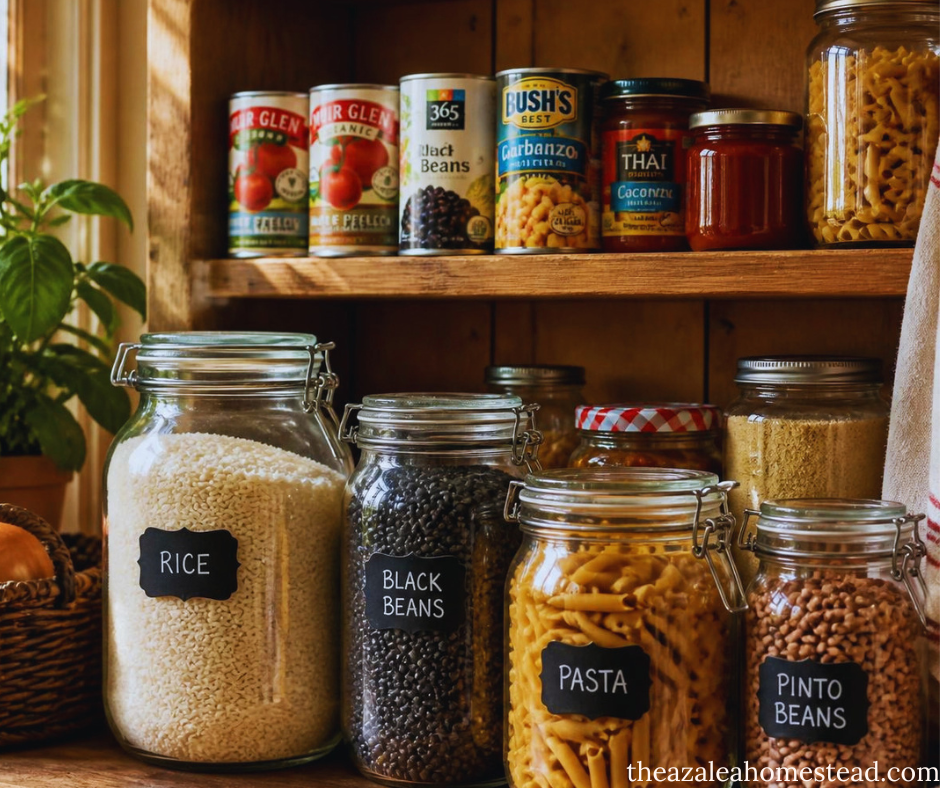
Having a well-stocked pantry is all about meeting your family's unique needs, not just filling it to the brim. Instead of aiming for the biggest collection of food, focus on what truly works for you.
If someone in your household is diabetic, having sweeteners and juice on hand is essential. If your kids can't eat anything without ketchup, make sure to keep that stocked up. There's no point in hoarding canned tuna if no one will touch it! You must tailor your pantry to reflect your family's preferences, budget, and available space, not what you see on social media.
Remember, you’re not stocking up for some huge event. You’re stocking up so that your family has food security on a daily basis.
How Much Should You Buy?
How much you’ll need to have on hand for your family will greatly depend on a couple of factors.
First off, think about how much your family typically goes through in a week or two. This will give you a solid baseline for what you need.
Next, consider your budget for stocking up; it's all about finding that sweet spot between what you want and what you can afford. Keep an eye on grocery store pricing cycles. Many staple items hit their lowest prices about four to six times a year, usually aligning with seasonal events and harvesting schedules. And don’t forget about your local farmers! They often offer far better prices than grocery stores since you’re cutting out the middleman, so it’s a win-win for your wallet and for supporting local businesses.
Be sure to use our PRINTABLE FOOD INVENTORY. It offers over 100 different items, so you can make sure every nook and cranny of your pantry is accounted for!

The "One for Now, One for Later" Rule
When your budget allows, grab at least two of the same item—one for now and one for later. Personally, I like to keep one in use and three on the shelf for my family of four, but if you're just starting out or on a tight budget, sticking with one for now and one for later is a great way to go.
This strategy lets you take advantage of awesome deals like Buy-One, Get-One Free, store loyalty discounts, and coupons, all while building a budget-friendly stockpile. Over time, as you keep repeating this process, you'll create a nice little cushion in your pantry. This means you'll always have essentials on hand, making those busy weeks a breeze and helping you avoid price hikes without stressing your wallet.
What NOT to Stockpile

As a lifelong resident of the Gulf Coast, I am no stranger to SEVERE WEATHER and HURRICANES. Of course, in 2005, Hurricane Katrina taught me the most. As a single, young adult navigating that unimaginable reality, I felt completely unprepared, both mentally and physically. I vowed never to experience that feeling again if I could help it.
One key takeaway from that time? When you’re in a crappy situation, you don’t want to eat crappy food. It just adds to the stress and makes everything feel even more overwhelming.
So, when you’re stockpiling your pantry, you also want to consider what not to stockpile.
Foods your family doesn't eat
More than you can properly store
More than you can use before expiration
Foods that go rancid quickly, such as brown rice, nuts & seeds, whole grain flours
Huge quantities simply because social media says it's a "stock-up price"
Food on credit that you can't afford to pay off
Advertisement
15 Staples to Buy When Prices Are Low
Wondering where to find high-quality and organic pantry staples?
Check out my friends over at Country Life Natural Foods. Their high-quality products are purchased from farmers, and their mission is to offer simple and affordable options that take the guesswork out of eating healthily. I love that they sell in bulk as well as smaller quantities directly to my door because this Momma is busy!
Try out Country Life Natural Foods for yourself, save 10%, and have high-quality and organic goods sent directly to your door. Let them know I sent you by using my affiliate code: THEAZALEAHOMESTEAD
My must-have staples:
Salt (Iodized for regular eating and non-iodized for home canning)
Meat (When Marked Down)
Baking Staples like baking powder & baking soda
Flavorings & Condiments
Before heading out for your next grocery run, choose five items that your family frequently buys and start keeping an eye on their prices. By doing this, you'll get a clear idea of what a good deal really is. The more you know about the usual prices, the easier it will be to spot genuine bargains when you're shopping.
Hey friend, if you enjoyed what you learned in this post, you should definitely check these out!
Did you know that we have a newsletter? It features some of our favorite recipes and free printables that are available only to our subscribers! And don’t worry, we hate spam mail and value your time. You’ll receive a copy of our latest email as a thank-you and then the newsletter, delivered every month. You can help our small family business by sharing us on Facebook, Instagram, and Pinterest. Click here to sign up for our newsletter today!
Advertisement


